I just realized I erred in the previous post when I wrote we had the entire day to see Nairobi's sights on November 21st. It must have been wishful thinking as there were a number of sights we would have loved to have seen. But we were told horror stories about how bad it could be to get to the airport because of possibly very heavy traffic. As a result, we had arranged to be picked up from the hotel shortly after 1 for the drive to the airport even though our flight wasn't leaving til 5:30. That meant we just had the morning to see the part of downtown Nairobi around our hotel
 Normally, we would have loved to while away time at the National Archives, just a few blocks from our hotel. However, this photo had to suffice on this visit.
 Just as in Addis Ababa, Ethiopia, shoe shiners did a booming business in Kenya's capital city, even in the rain.


 World War I Memorial:
 The National Library:

 Surprisingly. we hadn't seen any Kenyan flags since arriving in the country a couple of days previously. This woman's purse, though, sported the colors of the national flag.
 We didn't have time to taste any Swahili dishes as we wanted to spend our very limited time at the City Market instead.
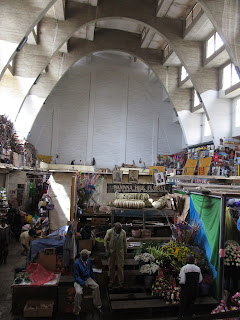
 The aged Art Deco styled City Market, our intended destination, since we had such limited time in the city! Plus, we were glad to be inside for a good while as it had been raining most of the morning.


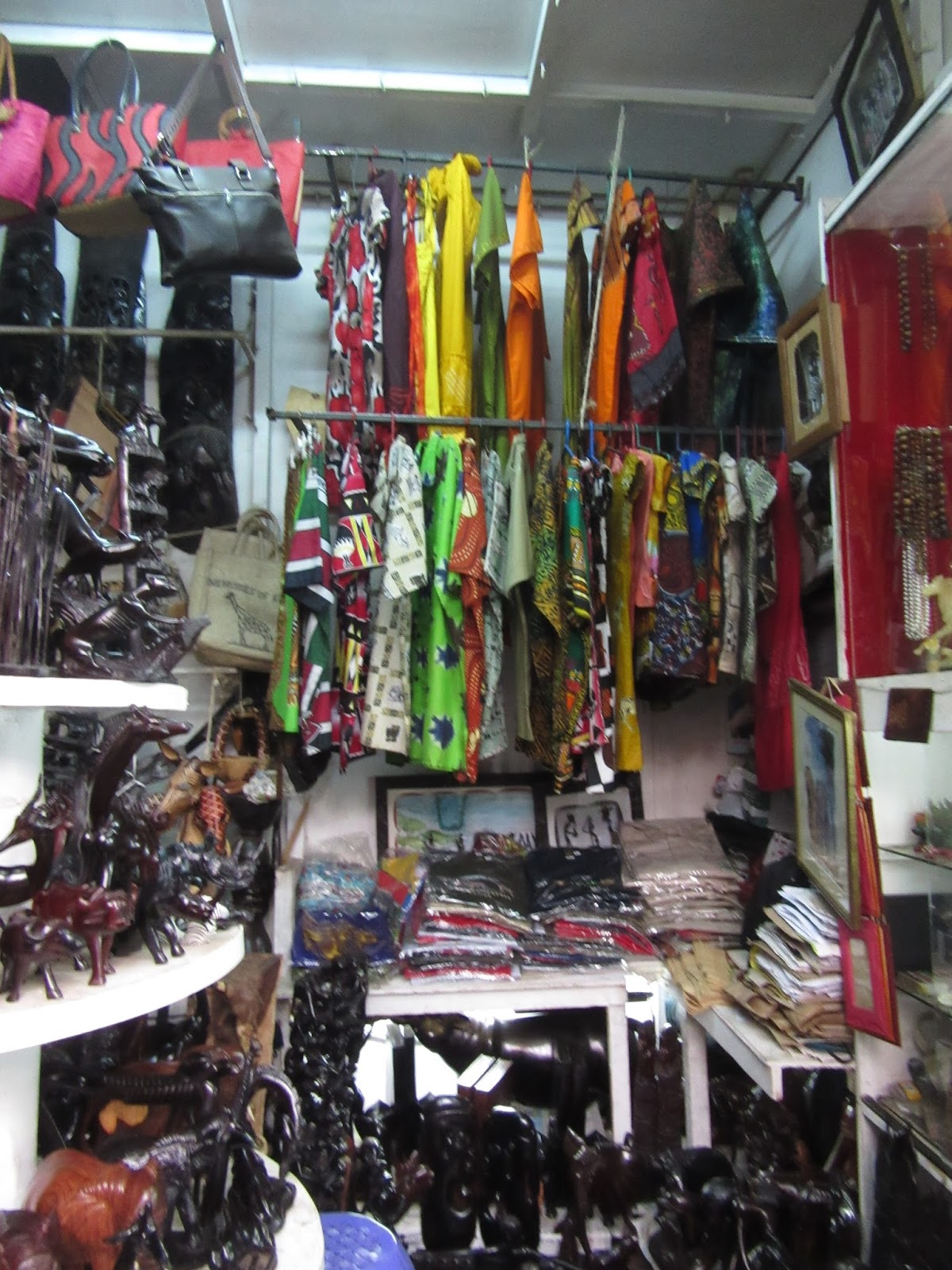
 The market, spread out over two levels, was crammed full of compact and very colorful stalls. Fruit and vegetables were stacked high in mounds but both Steven and I were far more interested in the huge array of crafts and curios.

 I had first seen and admired these kiondoo bags at the souvenir shop/rest stop en route to the Maasai Mara Game Reserve a couple of days ago. A kiondoo is a handwoven handbag made from sisal with leather trimmings. It is indigenous to the Kikuyu and Kamba tribes of Kenya. Those Kenyan weavers begin by stripping the sisal plant's outer layers, leaving the plant still able to grow. The weaver uses threads from the pale colored layers, that have dried out for a day, to make a bag.
 Once the weaver boils the threads to be used with water and dye to set the bag's colors, the weaving begins. Two single threads are twined to form one strong thread. Many such threads are woven to finally produce a sisal bag. It takes between two and three weeks to complete a bag. I couldn't resist buying one even though I am not sure when and where I will actually use it. Steven normally asks that of me when I am about to buy something on one of our trips!


 Strangely enough, there were ads everywhere in the downtown core for Juicy Fruit.
 I smiled when I saw this sign when I read the hot dishes were 'just like Mum's' as my siblings and I always called our mother 'Mum' in deference to her English upbringing. Our children also call me Mum.
 If we ever return to Nairobi, I hope we will time to discover the Arboretum, City Park and the National Museum in addition to the Archives. Our takeaway from our very brief visit to Kenya: Just like the people we had met in Ethiopia, the Kenyans we interacted with were exceptionally friendly and always wanted to make sure we were happy with the service we received. The hotel manager in Nairobi made sure one of his employees accompanied me to not just one, but two, grocery stores prior to our going to Maasai Mara so we could take snacks for the brief trip. His concern for my not getting lost was very touching and was a service we've never received anywhere else in the world.
So many Kenyans welcomed us to their country and said, in a seemingly very heartfelt way, how very glad they we were had come to Kenya. When I apologized to the hotel chambermaid for inconveniencing her for checking out of our room late before going to the airport, she immediately said she was there to help in any way and that there was no problem at all.
 We had been forewarned the drive to the airport could take as long as two hours but it only took 40 minutes once we got out of the city and away from all the Sacco minibuses. About a mile before reaching the airport itself where there were eight lanes of traffic, there was a security checkpoint. Passengers were required to exit all cars and vehicles to go through security. Meanwhile the cars were each wanded and searched before being able to later pick up their passengers just a few minutes later. Our driver told us it was part of the safety measures enacted in response to Al-Shabaab, the terrorist group. I wonder when other airports around the world will adopt similar measures to counteract the horrible acts of violence we have all read about recently at some of Europe's airports.


The Tom Mboya Statue memorialized the Kenyan trade unionist, educationist, author, independence activist, Cabinet Minister and one of the founding fathers of the Republic of Kenya. He spearheaded the negotiations for independence from England and was instrumental in the formation of Kenya's independence party, KANU. Mboya worked with then United States Senator John F. Kennedy and Dr. Martin Luther King, Jr to create education opportunities for African students. He was assassinated in 1969 at the age of just 39.

Nairobi's main street, Kenyatta Ave, was named after Jomo Kenyatta, a Kenyan politician and the leader of Kenya from independence in 1963 to his death in 1978. He is considered the founding father of the Kenyan nation. He is also the father of Kenya's fourth and current President, Uhuru Kenyatta.


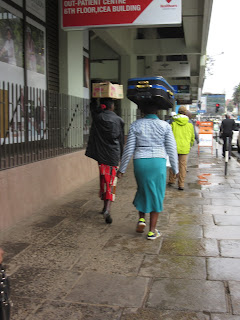
A common sight throughout much of Africa was of women carrying heavy loads atop their heads. I wonder at what age girls begin to learn to do that!


From the moment we walked in the market, we were greeted by vendors each saying 'Jambo, Jambo' which meant 'How are you?' I felt overwhelmed with each trader imploring me to come to his or her stall rather than allowing us to wander and look at our own pace undisturbed. We both love markets like this but I always feel so uncomfortable when presented with a such an aggressive sales force.




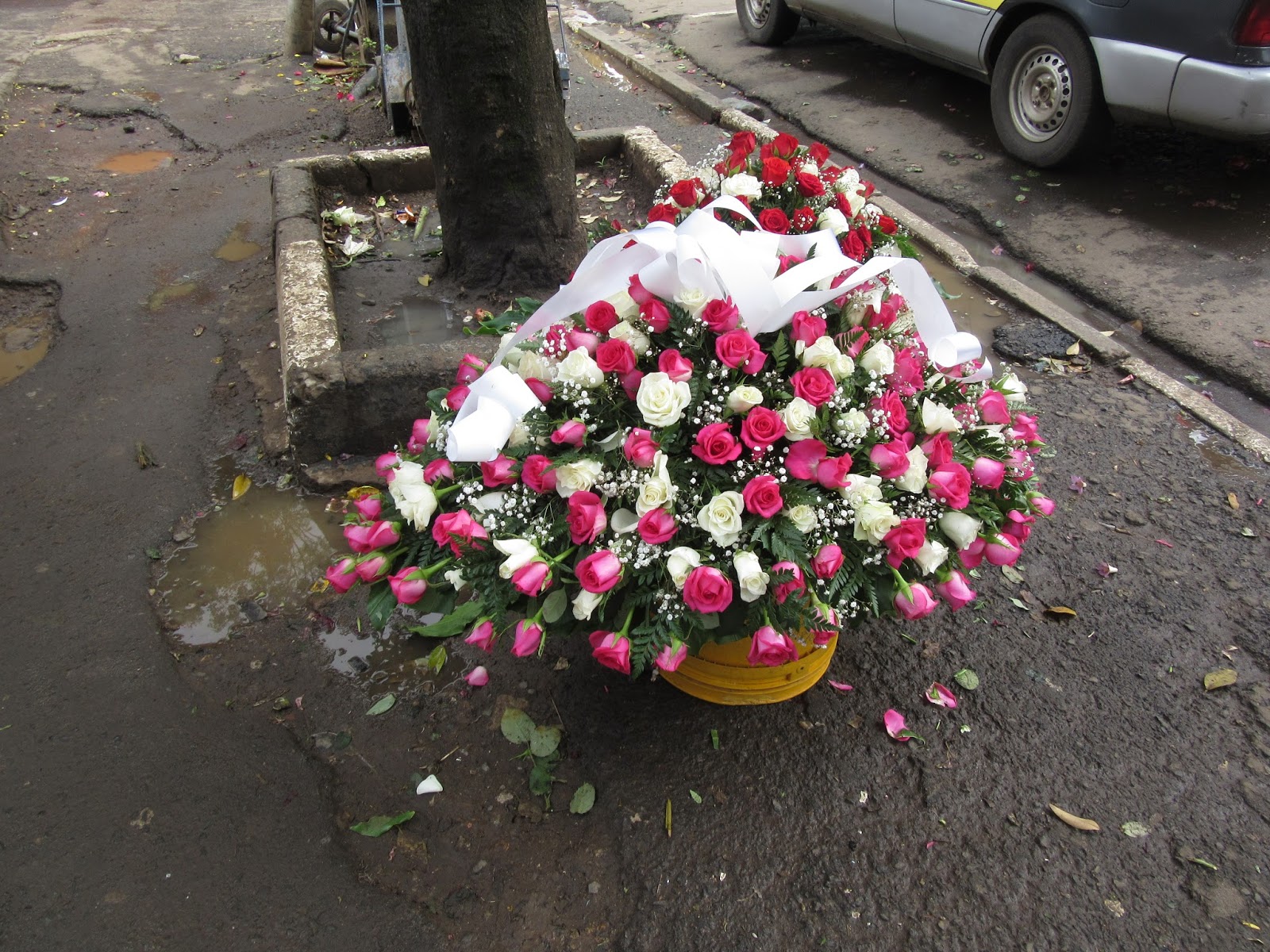
Outside, around the edge of the market, shops sold fresh meat, fish and seafood as well as dairy products. There were also a number of flower sellers.


So many Kenyans welcomed us to their country and said, in a seemingly very heartfelt way, how very glad they we were had come to Kenya. When I apologized to the hotel chambermaid for inconveniencing her for checking out of our room late before going to the airport, she immediately said she was there to help in any way and that there was no problem at all.


We had to go through gate security at 3:30, two full hours before our initial flight to Kigali, Rwanda. We were both agog at how incredibly lush and fertile the parts of Rwanda we had seen were. As you may recall, for 100 days in the spring and summer of 1994, Rwanda's Hutu majority killed an estimated 500,000-1,000,000 Tutsi, an event known as the Rwandan genocide. It was hard to think of that terrible period in the country's history when admiring the absolutely stunning green hills and mountains and thinking they were what we expected Ireland to look like. I hope we'll see that for ourselves in the fall of 2018 as we are very tentatively planning on visiting Ireland and other countries then.
After a brief stopover in Lusaka, Zambia, we finally arrived at the Johannesburg, South Africa airport at midnight local time. Unfortunately, Stevie, the owner of the Blue Mango Lodge, was an hour late picking us up so we were more than tad snookered after traveling for more than 13 hours. What a story Stevie had to tell on our drive to the Lodge: He was from Wales originally but had lived in Africa for the last 22 years, spending part of that time as a British mercenary. He and his Ugandan wife had a young daughter, White Cloud. When Stevie said he'd lived in Afghanistan, Steven asked him why. Stevie responded matter-of-factly that he'd been killing people there! That wasn't quite what we imagined a hotel owner's former profession to have been!
Posted on January 5th, 2017 from Littleton, Colorado. Now 'just' 21 more posts to go before finally finishing the blog!