LINKS TO PREVIOUS TRIPS


Other trips can be accessed by clicking the following links:

2013
Iceland, Finland, Estonia, Russia, Mongolia, China, Thailand, Cambodia and South Korea

2014
Germany, Poland, Austria, Hungary, Czech Republic, Romania, Bulgaria, Turkey, Israel, Jordan and Denmark

2015
Hawaii, Australia, Indonesia, Singapore, Vietnam, Laos, Myanmar, Malaysia, Nepal, India and England

2017
Panama, Colombia, Ecuador (inc. Galapagos), Peru, Bolivia, Chile (inc. Easter Island), Argentina, Uruguay, Brazil and Mexico.

2018
France (Paris and Lourdes), Armenia, Georgia, Azerbaijan, Kazakhstan, Uzbekistan, Kyrgyzstan, Spain, Andorra, Morocco (Tangier), Portugal and the Netherlands (Amsterdam).

2019
New Zealand, Australia, Ireland, Great Britain, Antarctica, Patagonia and Paraguay.

Sunday, October 2, 2016

9/25: Ohrid's Fabulous Pre-Renaissance Frescoes

Aside from the lake, Ohrid is most famous for its ancient churches, basilicas and monasteries where Sts Kliment and Naum, with the aid of the Bulgarian king Boris I, wrote their teachings and formulated the Cyrillic alphabet used in Macedonia, as well as many of the countries of the former Soviet Union.

This would be our day to visit some of Ohrid's churches which was very apt as it was a Sunday after all. All the more so since I am writing this on the following Sunday too. Ohrid is often referred to as the 'Jerusalem of the Balkans' because it once had 365 churches within its city limits - one for every day of the year! Aren't you glad they don't still have that many so we weren't able to visit a good chunk of them last Sunday! Most of the surviving churches were built during the Byzantine era or during the Serbian rule of the Middle Ages. A few of them have been reconstructed, but the majority are still filled with archaeological wonders that rival early Christian churches found in Turkey and Greece. 

We had been awoken by the church bells pealing from the small one just a few feet from the villa’s doors. However, when we got there mid morning, it was unfortunately closed.


St. Bogorodica Chelnica, a 14th century one just around the corner, was also closed. The only view of it was as we climbed higher up the hill.


The next church we came across was also closed but the keyholder or custodian saw us and kindly opened it for us. 

He only spoke Macedonian yet wanted to tell us all about the church he was so proud of. We nodded at the appropriate times but of course had no clue what he was talking about. We had very little tourist information about Ohrid so the only name we could find of the church was from the sign below. Normally, we're pretty good about deciphering signs but no this one, I'm afraid.


Whatever the name, it was a beautful little church with superb frescoes and we were lucky the 'keyholder' had opened the door for us.
This church was Tsar St. Constatine & Tsarina Helen and also sadly closed like the first two churches had been. What a shame the grass and weeds were so overgrown.

Just a few feet away was the back of Church of St. Bogordorica Perivlepta. To give you an idea of time, we had probably only spent about 15-20 minutes max from the time we had left our room at the Villa until we reached this fifth church! 
And here is the front of the church that was the seat of the Orthodox Church from the 15th century. The Byzantine church, which was built and painted in 1295, was also known as St Clement Church because his bones were buried here for 500 years. The church was dedicated to Mother of God Perivlepta which means all seeing. It was one of the most important churches in the cultural history because its frescoe paintings were so well preserved. Even from our untrained eyes, they were markedly different from ones we had seen previously. 

We were lucky enough to have been there at the same time when an English-speaking guide was acting as the interpreter for an Italians tour group being shown around by a priest. The guide mentioned how very rare it was at the time the frecoes were painted for the people to be painted with round faces as normally they were only painted with long faces. In addition, distinct facial features of the bishops and others in the frescoes were included and each person was also individualized. Also, showing people standing next to each other was very unusual, the guide said.


This frescoe depicted the Mount of Olives with the figures painted horizontally which was typical of the later Renaissance and not at all common to 1295. The first Renaissance elements appeared ten years later in Italy and that was why this was so remarkable.
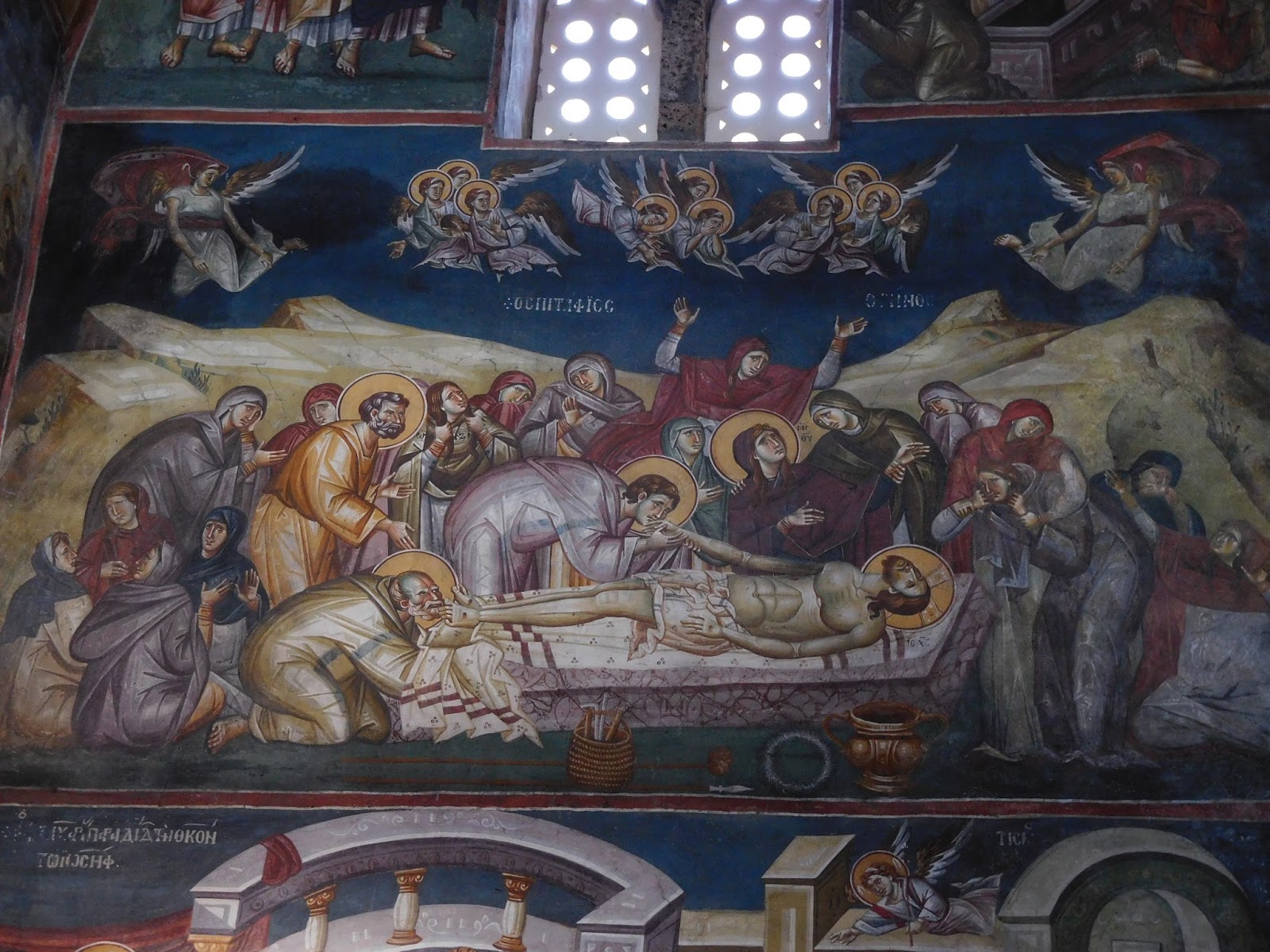
Over the entrance, the guide and the priest pointed out The Lamentation of Christ painting drawn with many emotions: the Virgin Mary is about to faint and women are holding her; the army of angels above the whole scene are crying. I hadn't noticed the moving, not static, clouds and the images of the Apostles. In addition, it was very rare to see anyone with upraised arms in any frescoe. 
The following photo is of The Transfiguration with Moses and the three disciples. The church was also considered to be so important because of the colors that were used at that time. The vibrant blue paint came from using lapis lazuli from Afghanistan. It was staggering to learn that one kilo of blue paint cost as much as one kilo of gold.
The guide said that the icon on the left always showed who the church is dedicated to. In this case, it was to the Mother of God and St. Kliment, the founder of the St. Ohrid Bishopric. 
It was amazing how the young painters showed that styles later adopted in the Renaissance were already current in Byzantine art. The frescoes have all the elements of Renaissance art except perspective. I felt so lucky that we were also the beneficiaries of the guide's and priest's knowledge of both the artistic elements and the religious interpretation of what we were seeing. It made visiting the church all the more worthwile for me. 

There was a separate icon gallery but we felt that we had seen and enjoyed enough icons and religious art to do us for a bit. After all, the day was still early and we had more churches to view.

Exiting the church took us to our first view of the city's walls which circled the old town. The first fortifications were built in the 5th century BC, but the oldest remains preserved are from the 3rd century BC. The fortifications were reinforced many times throughout history and the current ones are from the 10th century. 
The old city's Upper Gate was well preserved due to reinforcements made in the 16th century.
The huge Tmobile sign ‘welcomed’ us to the Antique Theater. We have seen Tmobile signs throughout much of Europe and I am all in favor of advertising but this did not seem to be the appropriate place at all for it.
The Antique Theatre was the only visible monument in Ohrid from ancient times and was constructed in the 3rd century BC. It is also the only Hellenistic theatre in Macedonia. Only the lower section of the theatre has been preserved. It is unknown how many people it seated since the upper section is missing. 
I counted the number of rows now visible and there were just 12.  It used to be used for gladiator fights and is now the location for a major festival and concerts during the summer. It was a lovely day so we just sat in the sun for a bit and enjoyed the peace.  
What pretty asters we saw as we left the theater ready to discover Car Samoil's Fortress and still more of Ohrid's churches.

Posted from Gjirokaster, Albania on October 2nd, 2016.

Saturday, October 1, 2016

9/24: Enchanted and Charmed by Ohrid, Macedonia

We got a morning bus from Skopje for the three hour journey to Ohrid, one of Macedonia’s most scenic destinations on a lake of the same name. The Villa Rustica’s owner kindly picked us up at the bus station in town which was a godsend as the villa was located in the Old Town, a good 15 minute ride from the center.

Situated on the shores of Lake Ohrid, the town of Ohrid is one of the oldest human settlements in Europe. Built mainly between the 7th and 19th centuries, it has the oldest Slav monastery and more than 800 Byzantine-style icons dating from the 11th to the end of the 14th century. After those of the Tretiakov Gallery in Moscow, Ohrid is considered to have the most important collection of icons in the world. 

If that weren't enough, Ohrid was declared to be an UNESCO World Heritage property for its natural values in 1979 and for its cultural values a year later. Now you can perhaps understand why we chose to come to Ohrid for a few days!

We could hardly believe our luck when we saw the view from our balcony of Lake Ohrid. It was a to die for view, no doubt about it. 
There were even kiwis growing on the tree on our balcony that we could have picked if we wanted. Not sure if they were ripe for the picking but they sure added to the lovely ambience.

Our room was about half the size of the one in Skopje and more than a little on the skuzzy side but it did have a private bathroom and a huge kitchen right across the hallway that no one else would be using so that was the ‘glass half full’ look at things!


As we walked down into town, all we could think of we sure hoped we wouldn’t need to lug anything big and heavy back up the hill as that would be a hard slog!
The rather steep descent to the harbor!

On the waterfront: Doesn't that sound like a novel someone wrote?!
We were so relieved that we were here in late September as hordes of tourists descend on Ohrid in the summer months. Slavic migrations created the name Ohrid  from 'vo rid' which means 'city on the hill.' Bulgarian Slavs arrived in 867 and the Ohrid literary school, the first Slavic university, was established by 9th century Saints Kliment and Naum.

There were a myriad of fishing trawlers and tour boats in the harbor. We checked out the latter ones as we were interested in taking a cruise on the lake, two days hence on Monday, when most of Ohrid’s attractions would be closed.


How beautiful seeing the swans and seagulls as we walked along the promenade. After being in Skopje, the Vegas of Europe for a few days, Ohrid was so picture perfect in an absolutely different way.


Al: I imagine you and your cronies would have fun casting your fishing lines here!
Wonder what these trees were. Pat: Any ideas from these photos?

There were some massive statues in the small park we had just walked by. After all, what town in Macedonia would be complete without its complement of statues, huh?!
What fun walking for a while next up the town's pedestrian street, Sveti Kliment Ohridiski aka St. Clement of Ohrid, gazing into the shops, cafes and watching the world go by.
The town was obviously famous for its Ohrid pearls because we saw a number of jewelry stores all advertising them on the mall. Ohrid pearls don’t come from oysters, but rather from the scales of the plasica fish in Lake Ohrid. The recipe for the pearls came from a Russian soldier staying in Ohrid in the 1920s who passed it down to just one family here.


Almost at the end of the mall was the Ali Pasha Mosque. We had learned from Saso, the tour guide in Skopje that 'Pasha' meant 'general' by the way.


When entering a mosque, there is always tile or stone before the carpet. It is Muslim custom, i.e. mandatory, that everyone must take off one shoe on the tile and immediately put the bare foot on the carpet and then repeat the process with the second foot. At no point should shoes be put on the carpet or bare feet on the tile or stone entry. Shoes are then put in cubbies provided in every mosque. There are often shoehorns provided in mosques but we have never ever seen shoehorns this gargantuan before!
Speaking of shoes, shoe shiners on the city streets have been a common sight in the Balkans.
Homeward bound:
As we went to bed that night, we were looking forward to discovering the next day why Ohrid was also called ‘The Jerusalem of Europe.’

Posted from Berat, Albania on October 1st, 2016.