At the museum, we were introduced to a term 'The Short Century' referring to the 20th century, an era that saw many of the most dramatic and extreme shifts in human history. The last century "was witness to the most violent wars, the largest human migrations, the rapid expansion of cities, the dominance of mechanical industry, and the rapid rise, conflict and collapse of expansive ideologies that underpinned them."
The temporary exhibition explored a number of artistic narratives in the Arab world, from representations of landscape and portraiture, responses to social and political developments and the rise of nationalism.
One of the features about the museum I loved so much and found intriguing was its long hallway, off which were about twenty rooms or galleries per side. Those galleries only showcased one or just a few pieces of art so there was an amazing sense of openness and space to enjoy and focus on each work of art.
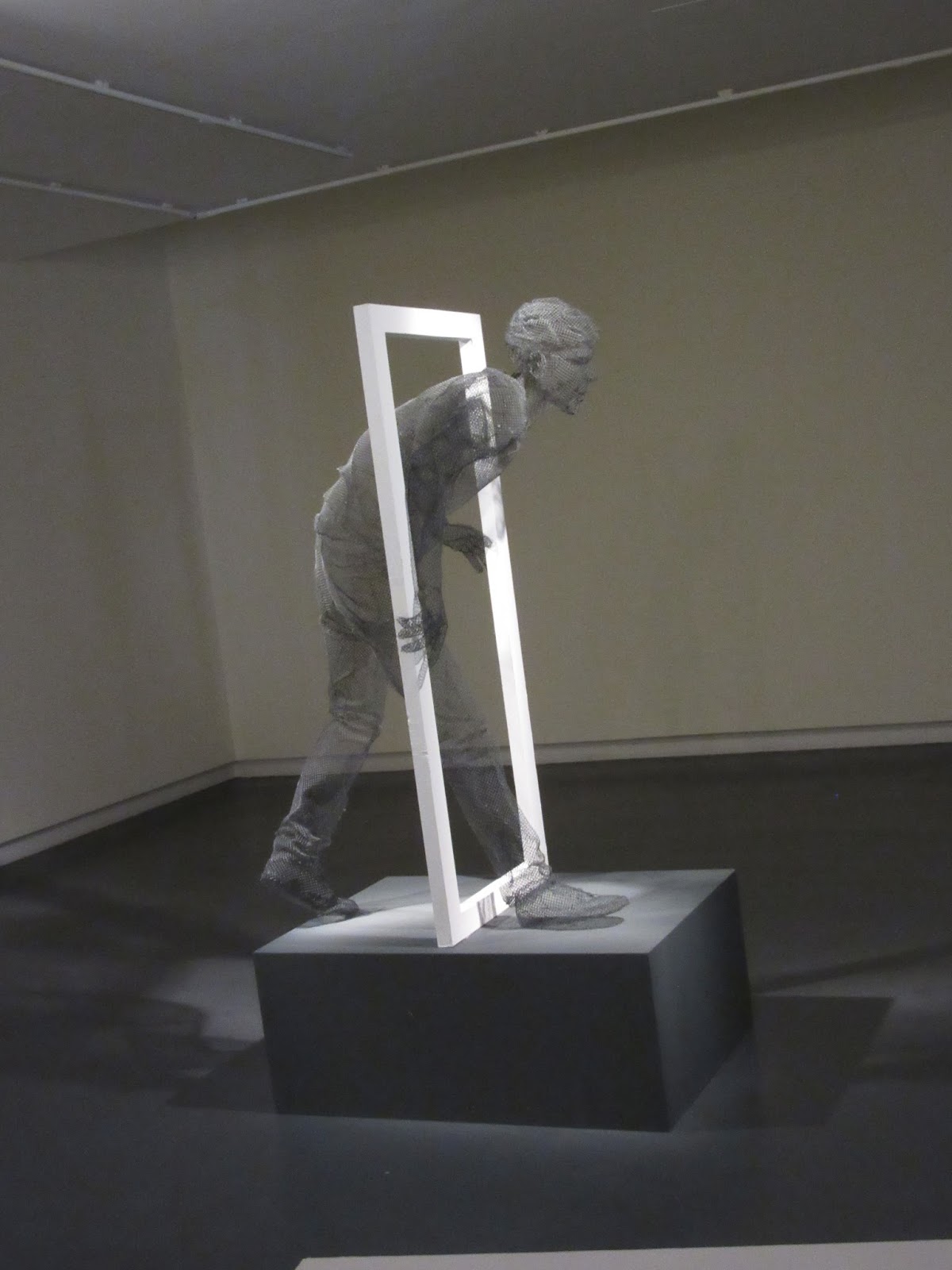
As this was the only piece of art in this gallery, we couldn't help but be drawn in to admire it.
The ornate windows in the hallway helped provide natural lighting to the exhibits.
The introduction to the next few paintings described that "lament takes on an universal and historical scale, transforming a single moment of mourning to an expression of loss that transcends time, nation and the individual." This painting, done by an Iraqi artist in 1978 when he was just 31, was titled Martyrs.
The bronze Standing Owl was created by an Egyptian sculptor in 1961.
Luxor Port (in Egypt where we had visited a couple of months ago) was painted by a 23 year old Kuwaiti in 1964.
Unlike any other gallery or art museum we've ever visited, the tags listing the artist's' name, birth date and painting title weren't beside each work of art but rather on the entrance to each room. That worked well as there were so few paintings or sculptures per room, of course.
Titled Moon Walkers: Women and the Veil series, the painting was done by a Palestinian artist in 1988.
A panel described that the power of painting was in its ability to record the artist's world and give it meaning. In the first half of the last century, Egyptian artists painted idealized scenes of landscape, travel, and the inhabitants of the locations they depicted.

One of the paintings in the museum's collection that had the most impact on me was called 'Sabra and Shatila.' The painting was included in a section called 'Art of the Resistance.' It was interesting to learn that modern and contemporary Arab art often "constitutes a medium to express the reality of social and political contexts. In countries which have or are still suffering the consequences of war and conflict, some artists commit to using art as a form of resistance. These works reflect the everyday struggle of people and the artistic expression represents an alternative weapon to violence. The 'Art of Resistance' also acts as a means of testimony to record history in order to avoid forgetfulness and the progressing erasing of identities."
At the end of the long gallery, museum staff were just installing some compelling new works of art. They were certainly a radical shift from those we had viewed in the other galleries!
Steven and I were so glad we had spent some time at the free Sharjah Art Museum as we had thoroughly enjoyed learning about both The Short Century and the Art of Resistance through the eyes and minds of Arab artists.
Perhaps this artistic installation at the Sharjah Art Foundation directly across from the museum should be labelled 'The Stairs to Nowhere'!
Just outside the museum was another of the Meeting Point signs we'd noticed ever since arriving in the UAE almost a week earlier. We never did find out what might necessitate Emiratis to congregate at such points.
Another five minutes' walk north along the Corniche brought us to one of the city's highlights, the superb Sharjah Museum of Islamic Civilization, originally built in 1987 as a traditional Arab market or souk.
The massive museum was topped by its distinctive golden dome.
The original building was constructed in stone intended to resemble that of the Natural History Museum in London which was built in 1881. The two-story building "explored the spiritual symbolism of Islamic culture in its design through the use of light and the traditional patterns incorporated in the building."
The ground floor had a wide ranging and superbly presented overview of various contributions made by Muslim scientists, artists and scientists to world knowledge over the last 500 years.
The Balance of Wisdom marked the high point of early Islamic weighing technology. The five parts of the balance, which was developed around 1115, measured the specific properties of metal alloys and precious stones.
A model of the observatory in Jaipur, India that we visited on our previous trip:
Leveling Devices: These instruments were models of leveling devices described by the 13th century mathematician Al-Marraqushi. The different designs performed the same function: the weight in the center indicated when the surface on which the instrument stood was level. Leveling devices like these were often used to construct water channels. Without an accurately designed gradient, the water wouldn't be able to flow where it was needed.
A model of Al-Jazari's water clock from around 1200. The sophisticated water-powered mechanism was hidden inside.
Machine for Lifting Water: In this water-raising machine, the oxen walked around in a circle pulling a beam attached to an axle which passed through the floor of the upper platform. The rotation of the axle caused four large hollow beams attached to dippers to rise and fall. As the dippers fell, they filled with water; when the beams rose, the water flowed out through the hollow beam into a water course at a higher level. The model was based on a description and illustration in the Book of Ingenious Devices by Ibn al-Razzar al-Jazari.
This modern globe based on the world map of Al-Ma'um revealed the extent of Islamic cartography. The original work was commissioned in the early 9th century and was based on numerous astronomers and geographers who were instructed to go out and compile a comprehensive new world map.
A world map engraved on a large silver plate by Al-Idrisi in 1154 was commissioned by the Norman King Roger II in Sicily.
Water wheels which captured the power of flowing water and used to grind grain, were widespread in ancient Rome, the early Muslim world and medieval Europe. The design was based on an Arabic manuscript by Al-Jazari and a surviving wheel built in 7th century Damascus to supply water to a mosque and a hospital.
Ship Mills: Floating and tightly tethered ship mills captured the power of the river directly. The fast-flowing water turned their huge water wheels while a series of gears transferred that power to the grinding stones within the boat. The advantages of a ship's mill were that is was movable and it didn't need foundations - useful features in locations where the river bank was heavily built up. The ship mill also rose and fell in line with the water level in the water. Where the river was narrow, the ship mill constricted the flow even more, which increased the river's speed and wheel-turning power.
I felt like a little kid again when looking at and learning about each of the displays as many of them had buttons to push to activate the models! Woohoo!
Raising Water: Water was often scarce and so Islamic engineers devised numerous ways of lifting water from lakes. streams and rivers and channeled it to higher ground where it was needed. Where the water flowed, they used its natural rushing power to drive water wheels. Where the water was still, they turned the wheels using animals and gears.
Islam and Astronomy: The need for accuracy in religious observations and calendar keeping was a major push in the development of Islamic astronomy. The lunar year observed in most Islamic countries is about 11 days shorter than the solar year. That is why religiously important seasons such as the fasting month of Ramadan advance slowly through the seasons. A full cycle takes about 33 solar years.
Islamic months begin when the thin crescent moon is first sighted in the western evening sky. Predicting when the crescent moon would become visible was a special challenge to Islamic mathematical astronomers. They had to relate its movement to the horizon - a calculation that involved complex mathematics.
The requirement to face Makkah al-Mukarramah, i.e. the holy site of Mecca in Saudi Arabia, when praying meant that astronomers had to find the direction of the Holy City from any given location in the Islamic world. They also had to determine the proper local times for prayers. Islamic astronomers resolved these problems through trigonometry. By the 9th century, they were already using the six modern trigonometric functions (remember sine and cosine, etc from your high school days so long ago!), five of which appear to be of Arab origin.
An equatorium, a term I had never heard of before, allowed people to work out the positions of the planets. The device was invented by an Arab mathematician in the second half of the 10th century.
After learning about so many scientific achievements made by Muslim scholars on the museum's first floor, we then explored the second floor. There, I was amazed to learn that Islam is the world's fastest growing religion. It has more than 1.4 billion believers, roughly one-fifth of the world's population. The word 'Islam' means submission or surrender to the will of Allah or God. I read that it began when Allah conveyed the first revelation to the Prophet Muhammad through the Archangel Gabriel in the cave of Hira in Makkah or Mecca as we know it in Saudi Arabia in 609. A Muslim's faith rests on 'the Six Pillars of Iman or Faith. They are the belief in Allah, in his Angels, in his revealed scriptures, in his Messengers, the day of Judgement and the Resurrection and Divine Predestination.
Shahada, which means The Profession of Faith, is the first pillar or tenet of Islam.
Salat, another pillar of the Muslim faith meaning The Five Daily Prayers, is important to devout Muslims.
Zakat, meaning Monetary Obligation, is the third pillar of Islam. It's an Arabic word which translates to blessing, purification and growth. The term is used to refer to the specific amount of money paid to support certain causes. Zakat signifies a monetary and legal obligation for Muslims to give alms to the poor and needy. More specifically, they must give 2.5% of their net income to charity annually. For Muslims, the giving of zakat is a way of strengthening society both economically and morally. Muslims are, of course, free to give much more than the legally prescribed amount voluntarily, either in monetary form or in kind.

The fourth pillar, Sawm, is fasting during the Muslim holy month of Ramadan. The fifth pillar of Islam is the hajj, the annual pilgrimage to Makkah or Mecca in Saudi Arabia, which takes place in the 12th and last month of the Islamic calendar known as Dhu'l Hijjah. All Muslims must undertake this pilgrimage at least once in their lives, if they are physically and financially able to do so. The rituals and the route of the hajj are precisely defined. Muslims are obliged to attend/go on (?) the hajj to purify their souls and to train them in patience and their submission to Allah. Devout Muslim pilgrims look forward to having their sins forgiven by Allah.
The Holy Mosque in Mecca:
The photo shows the crowds of Islamic faithful performing hajj:


Kiswah: Clothing the House of Allah: The heavy cloth of black silk lined with embroidered gold and silver threads that cover the Ka'ba, a small building in the courtyard of the Great Mosque in Mecca, is known as the kiswah. The tradition of draping the Ka'ba dates back to pre-Islamic times. The kiswah, measuring almost 46 feet high by 39 feet wide, is changed annually during the hajj pilgrimage during the ninth day of the final month of the Islamic calendar. The old kiswah is taken down and the walls are cleaned with rose water and incense before the new kiswah is put in place.

Makkah, the Blessed City for Muslims, has always been a sacred and venerated city. This status is enhanced by the Ka'ba or the House of Allah located within it. The Ka'ba, located at the heart of the central courtyard, provides the focus for people from all over the world during the annual pilgrimage. The Holy Mosque at Makkah al-Mukarramah can hold more than one million worshipers! It occupies five levels: two below ground and three above.
I read that each Islamic community has its own mosque. The materials used to build and decorate mosques vary from location to location. Each region or country has developed its own distinctive style depending on local materials. Some mosques are built of simple brick while others are adorned with marble, gold leaf and tiles laid in intricate patterns.
This mosque in a village just outside Vilnius, Lithuania was first mentioned in 1558 and is the oldest mosque still in use in that country.
A mosque in Poland:
This mosque, located in the small southern German town of Penzberg, was completed in 2005. As the public call to prayer is generally not allowed in Germany, its words were written on the minaret in calligraphic form.
Mosque decoration can be minimal or ornate. The walls and ceilings of many of the great mosques are often adorned with exquisite patterns. Islam forbids the decoration of mosques or religious objects with images of humans or animals. As a result, Islamic artists took their inspiration directly from the Qur'an, aka Koran, geometry and from abstract patterns of leaves and flowers in the style known as arabesque. Over the centuries, artists have woven these three elements into the most intricate patterns that proclaim the beauty of the Koran for Muslims.
The museum had a special exhibit called Spectacle and Splendour which contained Ottoman pieces from the Museum of Applied Arts in Budapest.
This late 18th century towel was embroidered with undyed cotton, colored silk and metal thread. According to Ottoman Turkish custom, diners dried their hands on fringed towels after washing before or after a meal.
The rotunda on the second floor was was gorgeous.
The museum's most outstanding feature was its majestic, gilt central dome located above the rotunda. It was decorated on the inside with an intricate mosaic depicting the night sky and the signs of the zodiac. Can you find yours below?
The Dome of the Rock in Jerusalem, which we were lucky enough to see back in 2014, is considered one of the most magnificent surviving examples of early Islamic architecture. It has changed very little since it was built in the 7th century. Architects used the most expensive materials of marble, mosaic and gold in its construction and positioned it so that it stood out against the skyline of Jerusalem as it still does today. When new, the Dome of the Rock heralded the arrival of the new faith of Islam. It was built in an area of Jerusalem that had great meaning to Muslims, Christians and Jews. In later years, it also came to signify the place where the Prophet's ascent into heaven took place.

Architectural Form and Function: Today, the Muslim Call to Prayer is made from a minaret attached to a mosque. However, minarets, weren't always conceived like this. Some minarets were built as free-standing monuments. One example is the 197 ft tall minaret of Jam in central Afghanistan that was built in 1190 by Sultan Muhammad of Ghur who ruled the area after defeating his opponents. Like most minarets, the Jam one is a very tall building that is easy for all to see. As an imposing symbol of Islam, the minaret signifies both the Muslim faith and the presence of a victorious Islamic power.
Some very attractive intricately carved doors and window panels:
Arabic script used in decorative architectural elements:
The 10 dirham per person entrance fee to the museum - all of $2.50 - was an absolute steal for one of the best and most enjoyable museums we've had the pleasure of exploring. I know you'll never believe me, but this post only touched on some of the absorbing displays of medieval Islamic scientific discoveries and superb Islamic arts and crafts including beautiful historic manuscripts, ceramics, glass, textiles and jewelry. It was one of the few museums we've explored that we, or perhaps just I, could easily have spent another couple of hours to take in the breadth of the collections!
As I mentioned in the previous post about our morning in Sharjah, it was so odd but also neat at the same time, coming across these huge copper coffee pots across the city.
 We'd forgotten that the sun set so early, about 3:30, in the winter. It was so dark just minutes later. That just added to the allure of the Tivoli Gardens, located in the center of Copenhagen, and a place for people of all ages to enjoy with entertainment, rides and more than 40 restaurants.
 Tivoli all lit up for the holidays:


 Fur coats were common in Copenhagen - certainly animal rights activists don't have a strong presence. On the city's almost one-mile long pedestrian mall, everyone seemed to be enjoying themselves on the Tuesday afternoon just a week or so before Christmas. Smokers were everywhere, it seemed - it was hard getting used to that after smelling so little cigarette smoke the last couple of weeks of our adventure.
 No one could plead ignorance as to where to dump their trash as there were painted footsteps to the garbage cans!

 Many European towns and cities are famous for their open-air Christmas Markets. It was fun wandering through the stalls in the Copenhagen Market that contained crafts and delicacies of all kinds.

 Everything at this booth was made of chocolate - yum, yum! The vendors sure made it easy for people wanting to buy items as we could pay with euros, Danish or Swedish or Norwegian kroner or USD.


 I certainly wasn't a gentleman but this 'gentlewoman' always eats fudge!
 Surely, only hardy Copenhageners (yes, that's the word for residents of Copenhagen!) would choose to sit outside at a cafe in the winter in the dark.
 Christmas displays after my own heart as they used recyclable books, disposable tableware, straws, bubble wrap, etc to create these festive Christmas designs.

 We'd both forgotten how insanely expensive everything was here: the cheapest bottle of water at the 7/11 was well over $3; a glass of water in a restaurant was $1.50; a croissant was a staggering $3.50; a loaf of bread was over $5. Our very small room was $100 per night and for that, we still had to hike about 30 feet down the hallway for the toilet and shower - we felt like we were in a hostel dorm, not in a hotel.